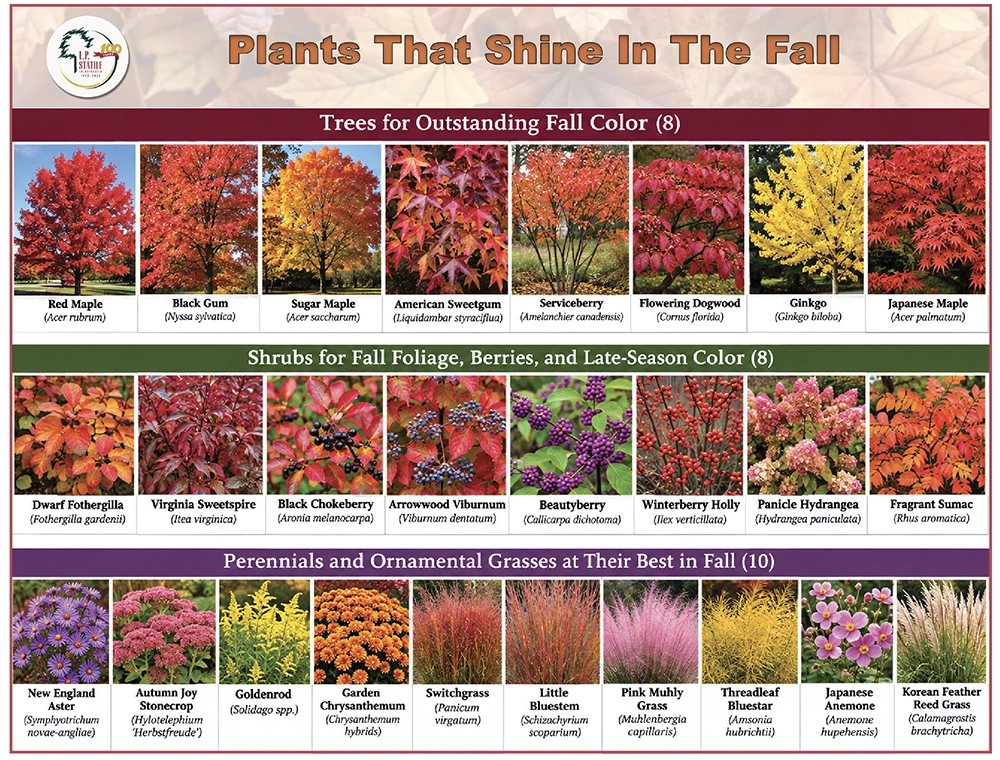
As fall arrives many plants that thrived in spring or summer can look tired and worn out. However, we are fortunate to have a host of plants that thrive in the fall. Here are 26 of our favorite plants that shine in the fall.
Best Trees, Shrubs, and Perennials for Fall Color
Northern Landscapes • New Jersey, Pennsylvania, New York & New England
Fall is one of the most spectacular seasons for landscapes in the northeastern United States. While many plants reach their peak in spring or summer, others are at their best in autumn, displaying brilliant foliage, colorful berries, late-season flowers, ornamental seed heads, and striking bark. The following selections are particularly well suited to northern landscapes, generally USDA Hardiness Zones 4–7, although individual growing requirements vary.
Trees That Are at Their Best in Fall
1. Red Maple (Acer rubrum)
Red Maple is one of the Northeast’s most impressive fall trees, with foliage changing from green to brilliant shades of scarlet, orange, and sometimes yellow. Its outstanding autumn color makes it a natural focal point in residential landscapes, especially when planted against evergreen backgrounds. Named cultivars can offer more predictable fall color.
2. Black Gum (Nyssa sylvatica)
Black Gum, also called Tupelo, produces some of the earliest and most intense autumn colors of any native shade tree. Its glossy summer foliage transforms into brilliant combinations of crimson, scarlet, orange, and purple, often with several colors appearing on the same tree. Its exceptional fall display makes it an outstanding specimen tree.
3. Sugar Maple (Acer saccharum)
Sugar Maple is famous for its magnificent autumn foliage, which ranges from golden yellow to vivid orange and fiery red. The combination of colors creates the classic New England fall landscape. This large shade tree is particularly beautiful when planted where its broad canopy can be appreciated, although it needs adequate space and favorable growing conditions.
4. American Sweetgum (Liquidambar styraciflua)
Sweetgum is prized for its star-shaped leaves, which develop a remarkable mixture of burgundy, purple, orange, yellow, and red in autumn. Its foliage often remains colorful later into the season than that of many other shade trees. The spectacular combination of colors makes it an excellent fall specimen, although its spiny seed balls can be a maintenance concern.
5. Serviceberry (Amelanchier canadensis and related species)
Serviceberry provides exceptional multi-season interest, but its orange, copper, and red autumn foliage makes it especially attractive in fall. Its smaller size and graceful branching structure make it ideal for residential landscapes, garden borders, and naturalized plantings. It also offers spring flowers and early-summer fruit for wildlife.
6. Flowering Dogwood (Cornus florida)
Although celebrated for its spring flowers, Flowering Dogwood offers a second spectacular season when its leaves turn rich burgundy, crimson, and reddish purple. Clusters of glossy red berries add additional fall interest and attract birds. Its layered branching structure makes the autumn foliage particularly attractive in woodland gardens.
7. Ginkgo (Ginkgo biloba)
Ginkgo is one of the most distinctive fall trees, with fan-shaped leaves turning a remarkably uniform, luminous golden yellow. The foliage often drops within a short period, creating a beautiful golden carpet beneath the tree. Male cultivars are generally preferred for residential landscapes because female trees produce messy, unpleasant-smelling fruit.
8. Japanese Maple (Acer palmatum)
Japanese Maples are among the most desirable ornamental trees for autumn color, with many cultivars developing brilliant red, orange, crimson, or golden foliage. Their delicate leaf shapes and sculptural branching add elegance to smaller gardens and foundation plantings. Fall color varies significantly by cultivar, making careful variety selection important.
Shrubs That Are at Their Best in Fall
1. Dwarf Fothergilla (Fothergilla gardenii)
Fothergilla is one of the finest shrubs for fall color, developing an extraordinary combination of yellow, orange, scarlet, and burgundy foliage. Individual leaves frequently display multiple colors, creating an almost glowing appearance in autumn sunlight. Its compact habit makes it ideal for foundation plantings, mixed borders, and smaller residential landscapes.
2. Virginia Sweetspire (Itea virginica)
Virginia Sweetspire produces brilliant burgundy, crimson, and purple fall foliage that can remain attractive well into late autumn. Its graceful arching branches and dense growth habit make it especially effective in mass plantings. Cultivars such as Henry’s Garnet are particularly valued for dependable fall color.
3. Black Chokeberry (Aronia melanocarpa)
Black Chokeberry combines brilliant red and orange autumn foliage with clusters of dark purple-black berries. Its compact, upright growth and adaptability make it an excellent choice for naturalistic landscapes and mixed shrub borders. The berries also provide a valuable food source for birds.
4. Arrowwood Viburnum (Viburnum dentatum)
Arrowwood Viburnum develops attractive fall foliage ranging from yellow and red to deep burgundy, depending on the plant and growing conditions. Its clusters of blue-black berries add ornamental interest and attract wildlife. It is especially useful in naturalized borders, screening plantings, and wildlife gardens.
5. Beautyberry (Callicarpa americana or C. dichotoma)
Beautyberry reaches its ornamental peak in autumn when clusters of intensely purple berries line its arching stems. As the foliage begins to drop, the berries become even more prominent, creating a striking display that can last into early winter. Callicarpa dichotoma is often the more reliable choice in colder northern gardens.
6. Winterberry Holly (Ilex verticillata)
Winterberry Holly is especially spectacular in late fall when its leaves drop to reveal branches covered with brilliant red, orange, or golden berries. The colorful fruit provides exceptional ornamental value into winter and attracts birds. Female plants require a compatible male pollinator nearby for reliable berry production.
7. Panicle Hydrangea (Hydrangea paniculata)
Panicle Hydrangeas often become more attractive as autumn approaches, when their large summer flower clusters age into soft pink, rose, burgundy, and parchment tones. Cultivars such as Limelight, Quick Fire, and Fire Light provide beautiful late-season color. Their dried flower heads can remain ornamental well into winter.
8. Fragrant Sumac (Rhus aromatica)
Fragrant Sumac produces exceptional autumn foliage in shades of orange, scarlet, and deep red. Low-growing cultivars such as Gro-Low are particularly useful for covering slopes, stabilizing banks, and creating colorful mass plantings. Its tolerance of challenging sites makes it valuable in northern landscapes.
Perennials and Ornamental Grasses That Are at Their Best in Fall
1. New England Aster (Symphyotrichum novae-angliae)
New England Aster is one of the most valuable fall-blooming native perennials, producing masses of purple, violet, or pink daisy-like flowers from late summer into autumn. Its colorful blooms provide a welcome contrast to changing foliage and are an important late-season nectar source for pollinators.
2. Autumn Joy Stonecrop (Hylotelephium Herbstfreude)
Autumn Joy Stonecrop reaches its peak in late summer and fall, when large flower clusters gradually change from soft pink to deep rose, copper, and rusty red. Its thick succulent foliage and sturdy upright stems provide structure, while the aging flower heads remain attractive after frost.
3. Goldenrod (Solidago species)
Goldenrod brings brilliant yellow color to autumn gardens when many other perennials have finished flowering. Its abundant blooms attract bees, butterflies, and other beneficial insects. Cultivars such as Fireworks offer graceful flower sprays that combine beautifully with purple asters and ornamental grasses.
4. Garden Chrysanthemum (Chrysanthemum hybrids)
Garden Mums are synonymous with autumn, producing dense mounds of flowers in yellow, bronze, orange, red, purple, and white. Their concentrated fall bloom makes them ideal for seasonal displays, entryway plantings, and colorful borders. Hardy garden cultivars planted early in the season have a better chance of overwintering than florist mums installed late in fall.
5. Switchgrass (Panicum virgatum)
Switchgrass becomes particularly attractive in autumn as its foliage develops golden, copper, burgundy, or red tones and its airy seed heads catch the low afternoon sunlight. Cultivars such as Shenandoah, Northwind, and Prairie Fire provide different combinations of color and upright structure. Its stems also add winter interest.
6. Little Bluestem (Schizachyrium scoparium)
Little Bluestem is an outstanding native ornamental grass that transforms from blue-green summer foliage to glowing shades of copper, orange, red, and burgundy in fall. Its delicate silvery seed heads add texture and movement. Cultivars such as Standing Ovation are especially effective in sunny, well-drained landscape beds.
7. Pink Muhly Grass (Muhlenbergia capillaris)
Pink Muhly Grass creates one of autumn’s most dramatic ornamental effects, producing clouds of delicate pink to rose-colored flowers above fine green foliage. When backlit by low autumn sunlight, the flowering plumes appear almost luminous. It performs best in sunny, well-drained sites and is most reliably hardy in warmer northern locations, generally Zone 6 and above.
8. Threadleaf Bluestar (Amsonia hubrichtii)
Threadleaf Bluestar is one of the finest perennials for fall foliage, developing a spectacular mound of brilliant golden-yellow leaves. Its fine, threadlike foliage creates a soft, feathery texture that contrasts beautifully with broadleaf shrubs and ornamental grasses. Although it flowers in spring, its most dramatic ornamental display often occurs in autumn.
9. Japanese Anemone (Anemone hupehensis and hybrids)
Japanese Anemones provide graceful late-season flowers in shades of pink and white, held above attractive mounds of dark green foliage. Their long flowering period often extends from late summer into October, making them especially valuable when many summer perennials have faded. They are excellent for partially shaded borders, though some varieties spread vigorously.
10. Korean Feather Reed Grass (Calamagrostis brachytricha)
Korean Feather Reed Grass reaches its peak in autumn, producing soft, feathery flower plumes that emerge with pinkish tones and gradually mature to silvery tan. The plumes shimmer in low-angle sunlight and create movement and texture in mixed borders. Unlike many ornamental grasses, it also performs well in partial shade.
Best Plants by Their Primary Fall Attraction
Fall feature | Outstanding choices |
Brilliant red foliage | Red Maple, Black Gum, Flowering Dogwood, Virginia Sweetspire |
Golden-yellow foliage | Ginkgo, Sugar Maple, Threadleaf Bluestar |
Orange and multicolored foliage | Fothergilla, Serviceberry, Fragrant Sumac |
Colorful berries | Winterberry Holly, Beautyberry, Black Chokeberry |
Late-season flowers | New England Aster, Goldenrod, Garden Mums, Japanese Anemone |
Ornamental seed heads and texture | Switchgrass, Little Bluestem, Korean Feather Reed Grass |
Long-lasting fall interest | Panicle Hydrangea, Winterberry Holly, Autumn Joy Stonecrop |
5. When These Plants Typically Look Their Best in Northern New Jersey
Actual timing varies with weather, elevation, and the growing season.
September
Goldenrod (flowers); Autumn Joy Stonecrop (flowers); New England Aster (flowers); Switchgrass (foliage)
October
Red Maple (foliage); Black Gum (foliage); Fothergilla (foliage); Little Bluestem (foliage); Beautyberry (berries)
November
Ginkgo (foliage); Winterberry Holly (berries); Virginia Sweetspire (foliage); Panicle Hydrangea (flowers)
Top 10 Picks for a Spectacular Fall Landscape in New Jersey
Black Gum — exceptional scarlet and orange foliage
Fothergilla — brilliant multicolored fall leaves
Red Maple — dramatic color on a large shade tree
Virginia Sweetspire — long-lasting burgundy foliage
Winterberry Holly — vivid red berries into winter
Threadleaf Bluestar — spectacular golden-yellow foliage
Little Bluestem — copper, orange, and burgundy grass
New England Aster — abundant purple fall flowers
Panicle Hydrangea — aging pink and burgundy flower clusters
Serviceberry — beautiful orange-red foliage on a smaller ornamental tree
Landscape Design Recommendation
The most attractive fall landscapes combine plants that offer different types of seasonal interest rather than relying exclusively on colorful foliage. For example, a Black Gum tree surrounded by Fothergilla and Virginia Sweetspire, with masses of Little Bluestem, Threadleaf Bluestar, and New England Asters, would provide a striking combination of scarlet, orange, gold, copper, and purple throughout the fall season. This combination would also provide ornamental interest across several months, with many plants contributing flowers, texture, or wildlife value during other seasons.